CryoKRAQEN: Kernel-Regularized Annealing for Quantized Embedding Networks in Cryo-EM Heterogeneous Reconstruction
Abstract
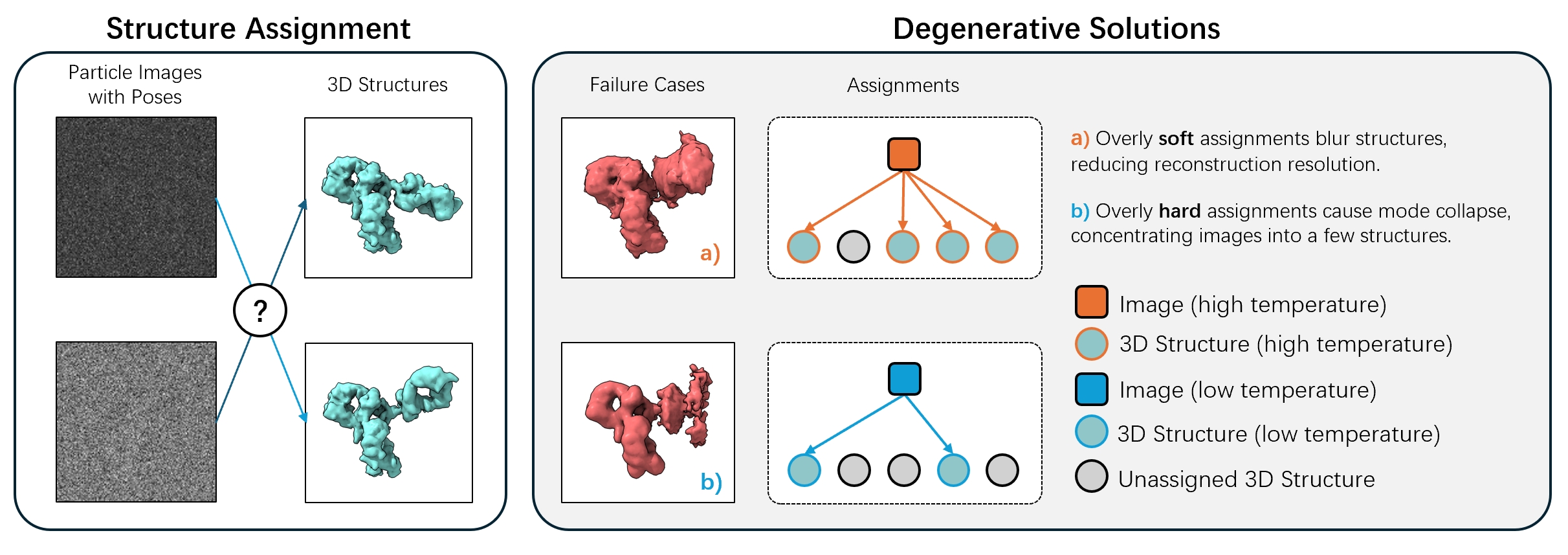
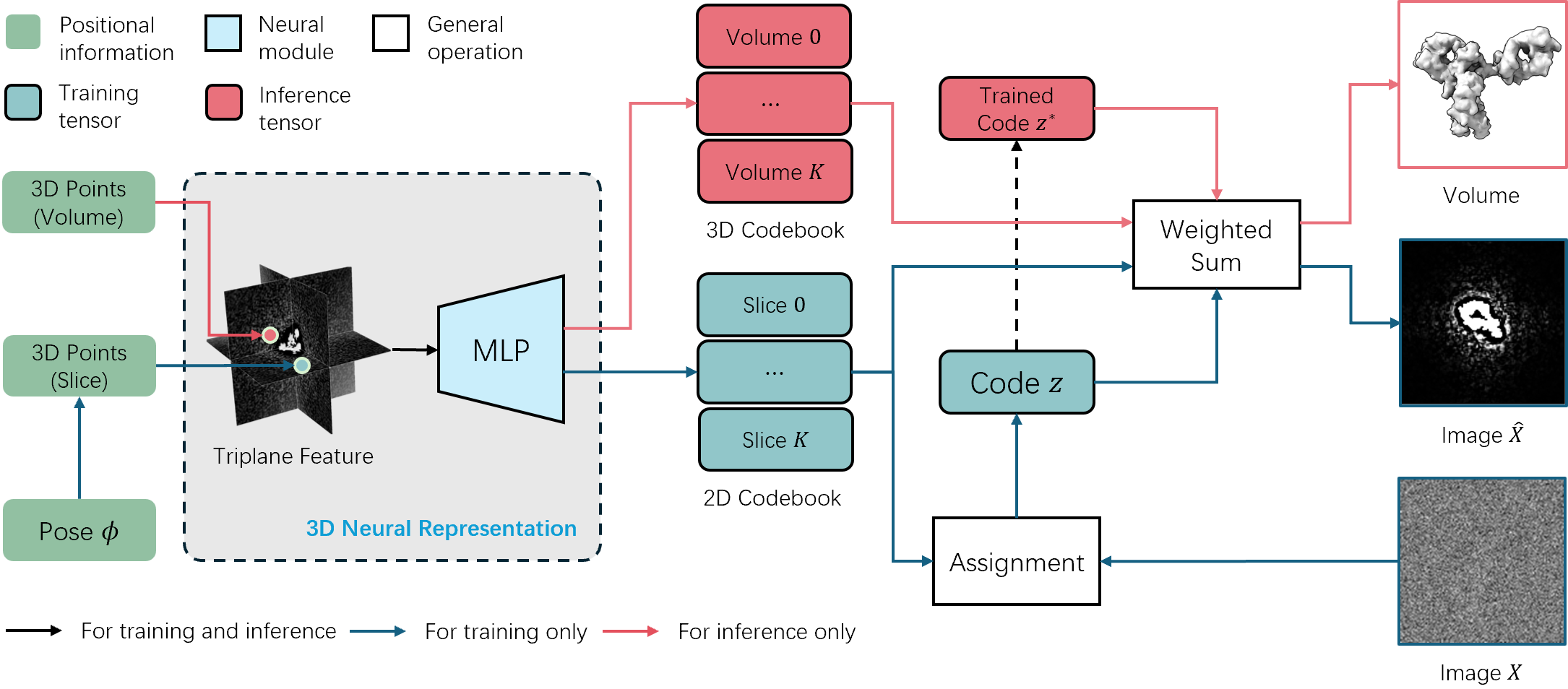
Heterogeneous reconstruction in cryo-electron microscopy (Cryo-EM) is fundamental for understanding macromolecular structural diversity, yet remains challenging due to extreme noise, continuous conformational changes, and ambiguous image-to-structure mappings. Existing neural approaches often rely on encoder--decoder pipelines or fixed codebooks, which can be computationally demanding or struggle with complex heterogeneity. We propose CryoKRAQEN, a decoder-only framework that integrates triplane implicit representations with kernel-guided latent assignment and quantized embeddings to improve stability and structural discrimination. The method avoids encoder dependencies and mitigates collapse during training, enabling accurate modeling of both conformational and compositional variations. Across diverse Cryo-EM benchmarks, CryoKRAQEN delivers competitive performance, robust reconstructions, and interpretable latent organization compared to state-of-the-art neural and classical methods.
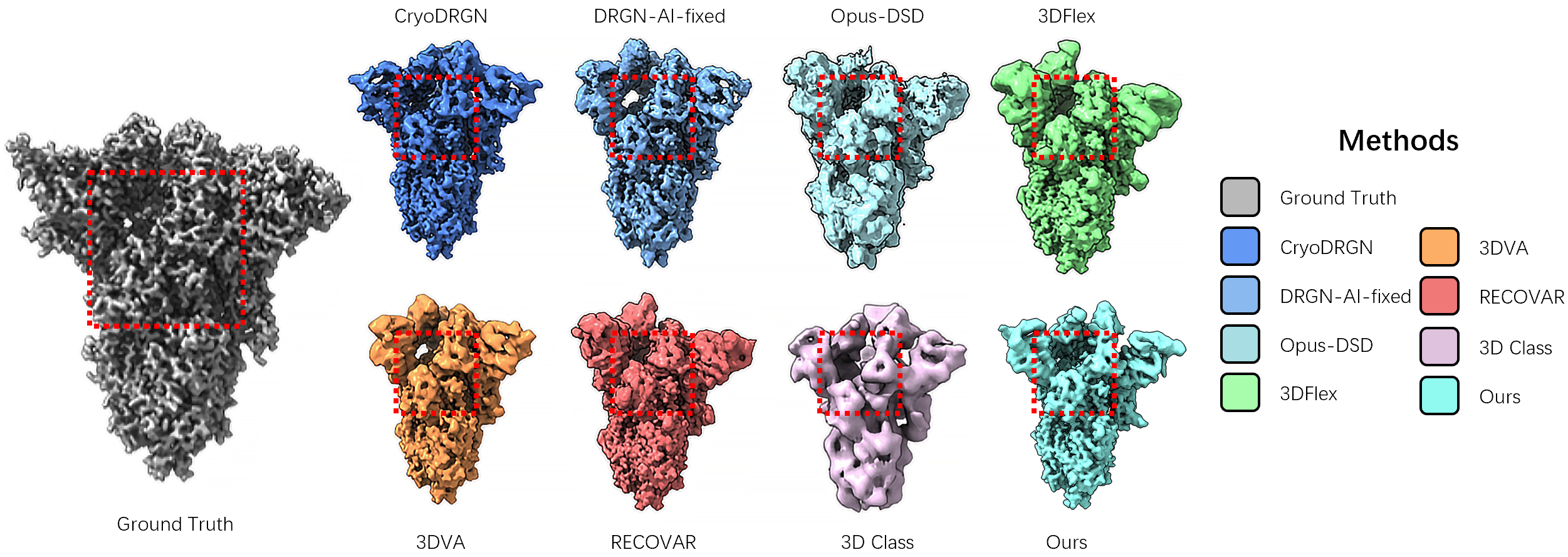
Comparison on Tomotwin-100 (compositional heterogeneity).
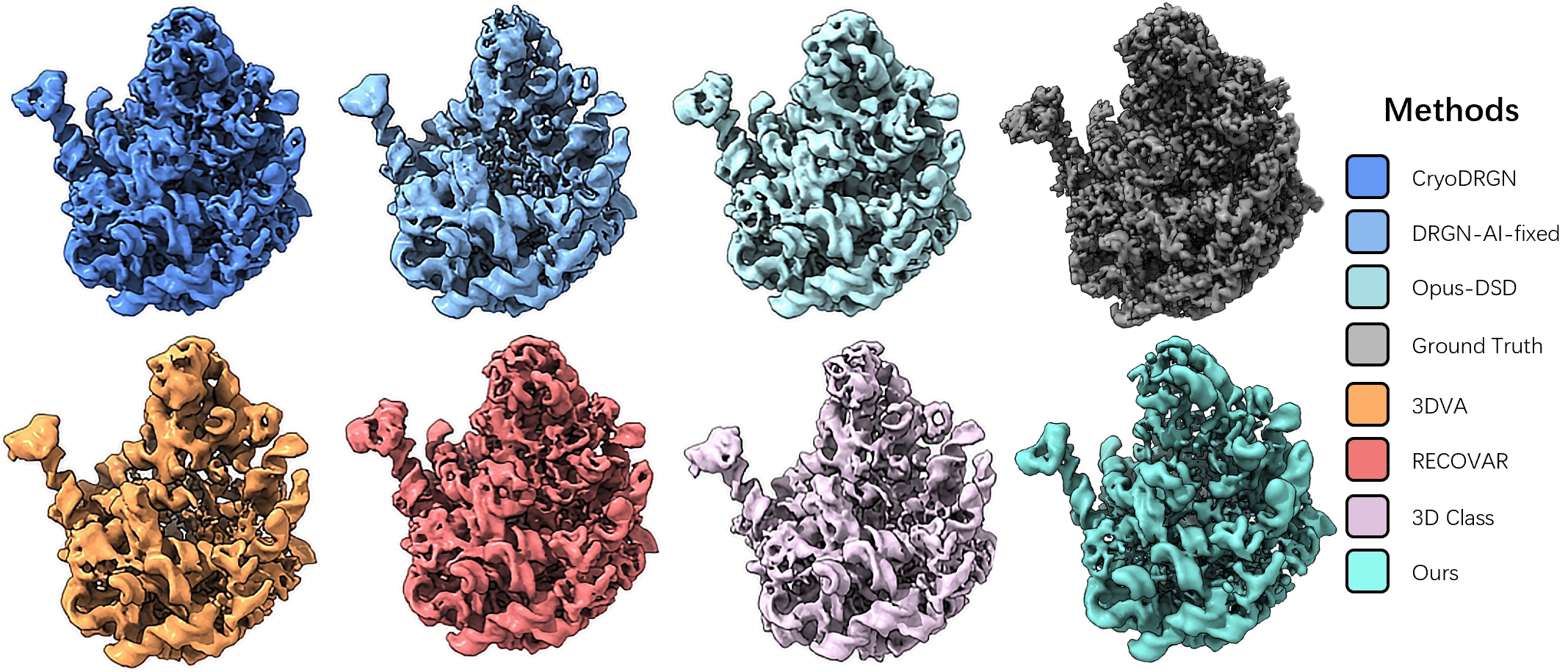
Comparison on Ribosembly (compositional heterogeneity).
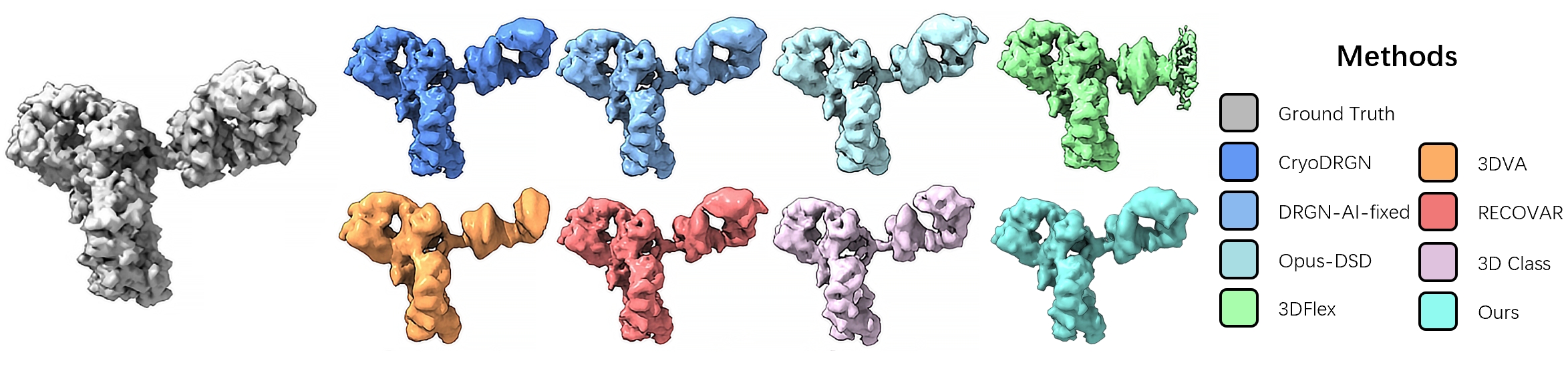
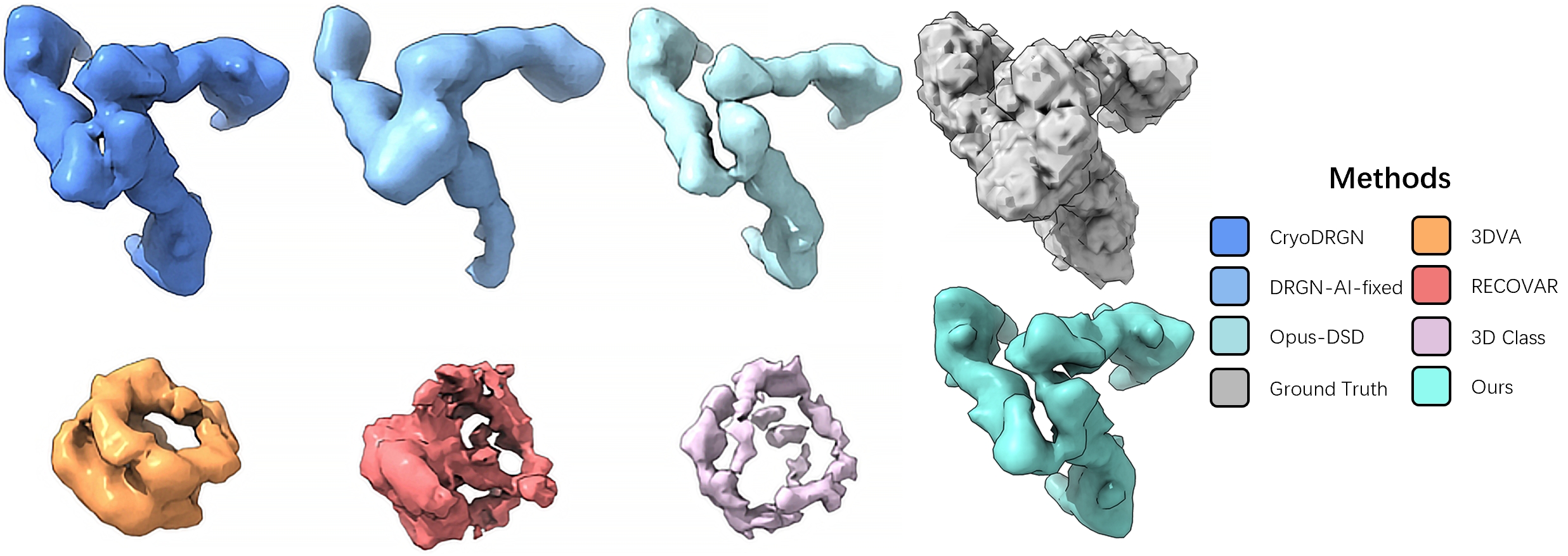
Comparison on IgG-1D (conformational heterogeneity).
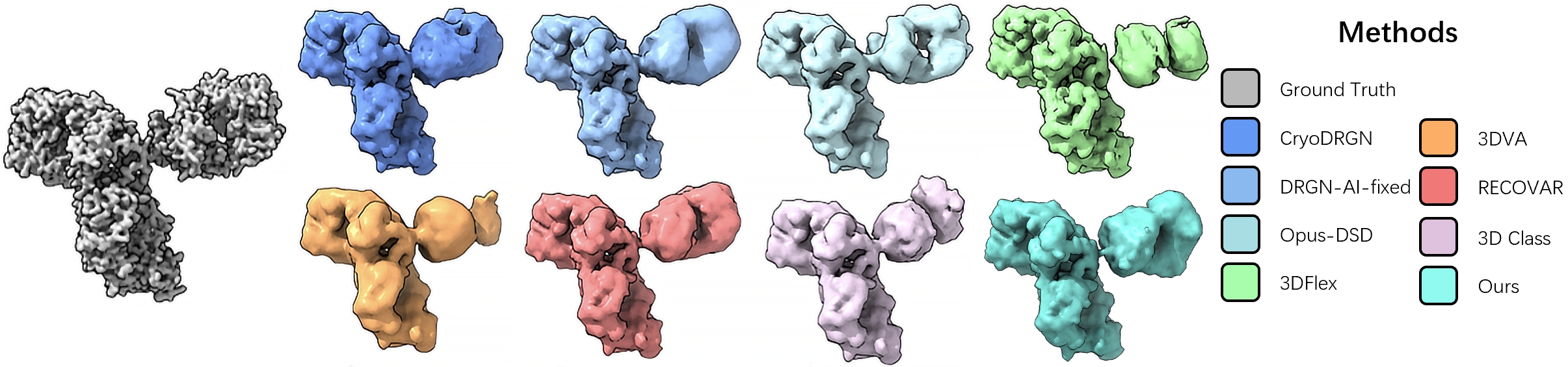
Comparison on IgG-RL (conformational heterogeneity).